Showing posts with label Menglembu. Show all posts

Friday, March 09, 2018

Journey to Nanyang

In the year 1909, soon after  the lantern festival 元宵 a young girl of 17 left her village in Mexian 梅县, China for Nanyang 南洋.


She travelled down the Meijiang river 梅江 and to the coastal port of Shantou 汕头.  From there the sail went up to catch the north-easterly winds and the boat set forth along the ancient trade routes of the sea heading south.  She landed in Malaya in March that year.


Around 1916, this daughter of the Chew family (邹), name See Moi  泗妹 married Kwet Chin 国祯, a widower aged 33 years old. Their matrimonial home was in Menglembu, an outpost that supported the many tin mines around the Kinta Lahat district.


The couple went on to have 6 sons and 6 daughters, over a span of 15 years.


Tuesday, April 10, 2012

what’s in a receipt – 36.11.21

1. Money home
松口, 圳头. 
Though it is a small piece of paper not  more than 14X7cm, what is printed and written on it tells a story of a different era, a different time.
 Whenever I walked past the ICBC Bank in People’s Park, Chinatown, and seeing the foreign labors from China lining up to send money home, I would visualize  a century and more ago, grandfather  would have been doing a similar thing –i.e.  remitting his hard earn money to his family in Songkou -
Perhaps with this thought in mind – it makes me feels a sense of connectedness & affinity to these folks. Our family too started off like them – albeit a hundred odd years earlier.

Well, by the time of this receipt dated 36.11.21 – that is,  the 36th year of the Republican era (民国)in 1947 November 26th,  grandpa was 64 years old, and had returned to his village for good.  He came to Nanyang – 南洋- and ventured to the tin mining outpost of Menglembu in is his early twenties, together with his 2nd brother.  
For the greater part of the next forty odd years and more – he was engaged in th timber industry – a service industry to the tin mines, supplying logs and planks for the palong ( in open cast mines) and the mining kongsi (dwellings for workers, operations headquarters,  depot  - all rolled into one) in the vicinity of Lahat, Papan and Menglembu.   His circle of business partners were mostly fellow Hakka tin miners  who hailed from the  neighboring  Hakka districts of South China.
Remittance to the home village was similarly sent thro the Hakka business network, in Ipoh.
On this  receipt, one can find two English words  – a)  LEEBROS –  which was the telegraphic code of the remitting company – Li Sanmao - 李三茂 - and b) Koo Kwat Chin – 古国祯 - in the red stamp  on the right bottom corner – grandpa’s chop which was a modernized version of the seal.
LEEBROS located at 39, Leech Street, was the main agent used by grandpa to remit money to the village.  The other agents were Eu Yang Sang, and thro Charted Bank.
This receipt was an acknowledgement that the sum of 5 million Republican yuan - - was duly received by the countersigned– on 21Nov1947, and stamped with the grandpa’s chop.
The person countersigned on the receipt was not grandpa, but was 4th uncle – with his nicely written namely as 古锦琳. – Gu Jinlin  (pinyin) . The person who remitted this sum from Ipoh – was dad -古锦宏 Gu Jinhong.
The establishment where this sum was remitted to, was located in the upper main street of Songkou town – Xinhe Zhuang - 信和庄松口上大街 – marked by the dark colored chop in the center of the receipt.

2.       Exchange rate 121 - Straits $ to Republican   1945 – 1947
How much was this princely sounding sum of 5million Republican yuan  equivalent to?
  Well, luckily the sum could be traced to accounting record.  From the handwriting it further confirmed that it was dad’s entry.

It stated : On Nov 06, a remittance of  $5million republican yuan was made thro Li SanMao to  - to be received by Daren大人手收 -  (Daren - an honorific old school address for one’s superior - grandpa) .  Following was a note in Suzhou character for a sum of $190.00 Straits dollars.
 This would make it at an exchange rate of $1= ¥26,315
Interestingly from the first record entry made just after the end of WW2 in Dec 1945 to the last entry made two years later in Dec 1947, the Republican yuan would have depreciated by close to 140 times against the Straits dollar!  The slide was especially drastic starting from 1947 -
Here’s a sample the exchange rate on remittance sent thro Li Sanmao, Ipoh, to Songkou, China.
10Dec1945          $1=¥256
16Mar1946          $1=¥625
27Jan1947           $1=¥2,040
26May1947         $1=¥10,000
26Aug1947          $1=¥11,674
23Sep1947          $1=¥Y14,705
06Nov1947          $1=¥26,315
09Dec1947          $1=¥35,714
Well, this is an unexpected lesson in economics coming out of the family history.  This was a period of turbulent upheaval in China. Perhaps we have a pretty good hindsight now, to come to think of it.
To grandpa who longed for his homeland – come what may home was where the heart was. In the hills lie his ancestors, and it would be there he would return.   Perhaps, the mountainous terrain of the Hakka highlands had nullified the impact from the hyperinflation, and dulled the distant din of the gunshots raging south.
PS –
1.       Republican Yuan  -indicated  as ¥    /  

Here to mean the existent currency in circulation at that time.  It could be called by different notation

Well, a google on the republican yuan  - leading to Chinese currency indicated that there were two period of hyperinflation in China that brought about the downfall of the regime.  One was towards the end of the Yuan dynasty - 元 - (1271–1368 ) and the next was during the end of the republican rule in mainland China  - 民國 - (1911-1949)

Chinese currency –


--//-

Friday, April 08, 2011

old photographs - 老照片 - the early generations

1906
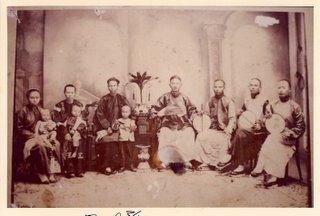
The photograph was taken at the Young Cheong studio - 容昌- in Ipoh.

Ipoh was written in Chinese as 壩羅 – Balo - instead of 怡保。

Seated in the middle was great grandfather and great-grandmother & their family. Grandfather the 3rd son was seated on his far left .

As the photograph was not dated, the year 1906 was derived at from the age of the baby seated on the lap of the lady dressed in peranakan attire on the far right of great-grandmother. The nyonya lady was grandfather’s wife.

According to the record in the family genealogical record – grandfather’s son was born in the year of Emperor Guangxu - 光緒乙巳年 – in the 7th lunar month. That would be Aug 1905.

Assuming that the baby to be about 6 to 8 months’ old, that would make put the photograph to be taken between Feb – Apr 1906.

Grandpa was born in the year 1883 – and he would be 23 years old.

What a dashing scholarly figure he looked - in his traditional garb, wooden cloth shoes with thick soles and complemented with a round fan. Being the 3rd in his family – he was known as Gu San - 古三– to his town folks in later years.

It was common then for young men to marry local peranakan ladies. Grandfather's first wife the nyonya maiden was from the Xie Family- 謝氏.

The Gu family genealogy - 古氏族谱- recorded that she gave birth to two sons and died at an early age of 22 years old. Only the first son survived to adulthood.

Grandfather's two other brothers were in the picture. 2nd granduncle was seated next to great-grandfather, and the one next to grandfather was 4th granduncle.

2nd granduncle's wife was seated next to great-grandmother. She was from China.

As a Hakka’s it was not a custom for the womenfolk’s to have dainty bound feet – for the Hakka women folks had to work in the fields, tending to the housework bringing up kids, and attending to the elder in-laws, while the husband venture out to work in distant land.

What was the occasion for this family photograph? Why was  great-grand father and great-grandmother & all the family members here in Ipoh. Grandfather and 2nd grandunlce and their families stayed on, while great-grandfather, great-grandmother and 4th granduncle returned to China. How long was their stay in Nanyang, and when did they return to China?

If I remember well, I heard from dad that great-grandfather initially went to Burma, that is Myanmar, but later made their way to Malaya. As such grandfather could have left the village for Nanyang - 南洋 - in the late 1890/s or early 1900/s.

Photographs of great-grand fathers’ and great-grandmothers’ graves in China, used to hang in the old house together with this photograph.

These questions of when the early generations left their village and what was the occasion for the gathering in Ipoh / Menglembu - were family history lost in antiquity.

Perhaps, some living elders who still have the answers, be it here or back in the village in China.

1926

This wedding photograph was badly soiled when it was salvaged from the old house 1A.

As a wedding memento - it was clearly dated and the event and date recorded in ink at the back of the photograph -
映於〡〩〢〧年乃民國〡〥年 六、二六号
陰暦 丙寅五月十七日

It was taken on the 26June1926, the 15th year of the Republic in the lunar year of binyin on the 17th day of the 5th lunar month. The bridegroom, age 21, standing in the middle of the photograph in black suit and bow tie was the baby in the 1906 photograph.

Grandfather was seated on the right of the bridge, a maiden from the Liang family -
梁氏. Grandpa would be 43 years old.

Seated on this right was his 2nd wife, and our immediate grandmother. His peranakan wife – as we heard died at a young age and subsequently grandfather re-married. Grandmother was born in China and she was from the Zou family - 鄒氏.

Seated on grandmother’s lap was a baby - about six months’ old. He would be our 3rd uncle, while the groom being the eldest son of grandfather was our 1st uncle. The first of grandfathers’ sons from his 2nd wife, was dad. Dad was on the far right among the children seated on the floor in the front row. He was 2 years old then.

All in grandfather had six sons and 6 daughters that lived to adulthood - one from his firt nyonya wife, and the rest from his 2nd wife.

2nd granduncle and his wife, were seated on the right of the photograph. The adult womenfolks were his daughters, as we know that 2nd grandmother had three girls, and did not bore any male.

The house where this photograph was taken was in Menglembu. It was probably behind 1A across Jalan Lee Man Hin. That was before they moved to another house where the current police station is located. When I was small, I heard that dad was born in that house - and it was probably this house in this wedding photograph.

Interestingly, there were two big lantern's - one was written with the characters - Gu Family and the other - Welcoming the bride. It was the custom and tradition of then, and these red character lanterns were too seen in the peranakan wedding ceremony.

Grandfather returned to China in 1946 after the the Pacific War ended. By then he would have left his village close to 50 long years. His vision then was to bring his brood back to China.

However, before it could materialise, he passed away in 1948, and his wife, his children and the grandchildren remained in Nanyang...


Postscript:

This 1926 wedding picture, together with the 1906 photograph, was left behind in 1A when the family moved house in 1983. In the late 1980/s or early 1990/s went back to 1A and found these two photographs on the floor in dad’s room, beneath the windows. The photograph frame had rotted badly after years of exposure in a dank and humid room where water would seep thru the windows during heavy rain.

The numbers written in the back of the photographs consisted of Shuzhou numerals蘇州碼子– which was the numerals for Chinese accounting then -

Reference:

1. Chinese calendar – 万历年
http://www.51baozhi.com/wannianli/

2. Shuzhou numerals蘇州碼子 http://en.wikipedia.org/wiki/Suzhou_numerals

3. 古氏族谱- 革公派 - Gu Family Record - Ge-gong branch -

卅五世 ( 35th Generation)

顺元公之子
鴻慶號雁如諡謹慈配李氏
生四子永明永亮永禎永祥

卅六世 (36th Generation)

鴻慶

長子 永明
幼亡係錦榮錦麟錦桂房承鼎

次子 永亮
清光緒辛巳(1881)年十?月廿三丑時生配李氏光緒庚辰八月廿六日生生一子錦麟嗣半子錦宏妾孫氏現生一子錦添

(2nd granduncle died in Lahat, Perak, and 2nd grandaunt in Menglembu. They were buried in the 'old hill' cemetery, Menglembu.

三子 永禎  
清光緒癸未年(1883)十月十七曰子時生配謝氏操烈廿二歳生二子錦榮錦鑫継妻鄒氏光緒壬辰(1892)八月廾日丑時生現生三子錦宏錦環錦琳 (後錦朱錦昌)

民國卅七年戊子年五月卄五日寅時去逝於梅縣松口諡慎詒公
民國卅七年戊子金秋月吉曰葬

Grandfather passed away in his home village Songkou, Meixian, in 1948, and buried there. While grandmother passed away in Menglembu in 1961 and buried in 'new hill'.

All their sons and daughters have too since passed away.

四子 永祥
光緒戊子崴 (1888)四月廿七自曰配李世

(4th granduncle and family remained in China. The elders from China mentioned that one of his daughters migrated to Malaya too).

Update -
12.04.2012 - replace  photographs re-taken on 13Mar/Menglembu

/--/

Tuesday, April 05, 2011

clear & bright – 清明

Living in the tropics where the climate is hot and humid the year round, an indicator of the passing of the seasons is the traditional festivals.

Qing Ming falls on 05April this year. Variously it is translated as the Tomb-Sweeping festival and it is a major event in the calendar of traditional Chinese festivals.

Its importance as one of the major traditional festivals is perhaps re-emphasized when Mainland China officially declared Qing Ming as a public holiday in 2008. Qing Ming has been a public holiday in Hong Kong and Taiwan all this while, though not a public holiday in countries in SEA with large Chinese diasporas. Qing Ming – in itself is one of the 24 solar nodes in the Chinese lunar calendar – as such it always falls with the first week of April each year - usual on the 4th or 5th of April.

Another traditional Chinese festival fixed by the solar term is Winter Solstices – which usually falls on the 2nd or 3rd day before Christmas.

The Qing Ming as I recall as a child:

When we were snall mum would used to tell us that a hundred days’ after Winter Solstice it would be the Qing Ming festival. Truly so – to be exact – it’s 104 days after deep winter – Spring is in the air.

However, in the tropical climate – there is nothing much to remind us of spring time, other than this festival – the big one after the Lunar New Year festivities. It’s the time again where we would have chicken for dinner.

Days before the festival – mum would earnestly prepare the offerings that would she would take on that day to the grave of the ancestors. There were the paper offerings of gold & silver – with pieces of paper sutra that she would bundled together with candles and joss-sticks. As the number of sets to prepare was quite many – she would mark each bundle neatly with a pencil to identify the relation that she had prepared for.

Other than the immediate members on dad’s side of the family, she would also prepare the offerings for members from her own side of the family, namely he mum, dad and her grandmother. This was because – she was the only daughter around that had the time to perform this annual filial task – as both her brothers had returned to China in the early nineteen fifties to support - the New China in construction.

As far as I could remember, the tomb-sweeping obeisance had never been observed on the actual day of Qing Ming. For one – it seldom fell on a weekend – a non-workday, and even if it was on a week-end, the ceremony was observed a week or so earlier for some feng-shui reason. Usually it would be by word of mouth round the community to perform the prayers earlier.

We would set off early at 8:00am where the air is till cool. It’s an extended family spring excursion of sort – with the uncles, aunt, cousins, nephews, nieces all in tow. It would take a half a day to make the rounds making the obeisance – with clearing of the weeds.

First it was to tombs of grandma and 5th uncles, on the new hill. After which it was to the old hill where 2nd granduncle and grandaunt – the elder brother of grandfather - were buried.

After these observances and prayers on dad’s side of the relation, mum would then make her way to offer prayers on her side of the relations. By the time all the prayers were done, it would be close to noon, and the sun is high.

As with other traditional festivals, the Qing Ming tomb-sweeping observances imparted an invaluable part of the Chinese culture and tradition to the young impressionable mind. For one it passed on values of filial piet. It also promoted family kinship and it was one of the rare occasions where the extended family of the same progenitor went on outing together – albeit to the hills.

Our elders would tell us stories that back in China then – Qing Ming festival would spread over many days- as they would literally had to hike to remote hills where the ancestors were buried.

The tread to the cemetery was also a geography lesson on China of sort. In each of the gravestone was carved the province and locality of deceased. Dad would point out to where these localities were in China.

The early migrants were mainly Cantonese and Hakka from Southern China. As such - 梅县 – Meixian, 焦岭 - Jiaoling, 五华-Wuhua, 兴宁-Xingning. 平远-Pingyuan, (the嘉应五属the five districts that make up the greater Jia-Ying district),大埔-Dapu, 三水-Sanshui,东莞-Dongguan, ,江门-Jiangmen,清远-Qingyuan – became familiar names.

Well, so much for Clear & Bright..


Postscript –

1. The photograph - Menglembu cemetery view from the ‘old hill’.

The cemetery should be more than a century old. On Qing Ming tomb-sweeping day , the first stop would be to the - Dabogong Shrine - 大伯公 庙 –dedicated to the God of Earth – the guardian of god of the cemetery - wooden building painted red.

Kledang Range - west of the Kinta Valley – in Perak, is located in the background. The grave in the foreground was built by the Menglembu Jiaying Assocation - a Hakka clan association. It was a - 总坟–a symbolic master grave dedicated to fellow sojourners from the home counties. It was consecrated 1941, Oct - 民国辛巳年.

The couplet:

萬里青坐凝紫氣 - a ten thousand li sitting on the green, the auspicious cloud gathers
五城芳草映斜陽 - the fragrant grass from the five districts, reflecting in the setting sun
澤蔭五城 – Beneficence to the five districts

References:

1. Qing Ming http://en.wikipedia.org/wiki/Qingming_Festival

2. Menglembu Jiaying Association 万里望嘉应五属会馆
http://baike.baidu.com/view/286454.html


-//-

Friday, January 29, 2010

萬里郷情 芽籠望

上个月趁着长假回家乡去走了一趟。这三几年来 ,一年一度的回乡都转到阳历年年未十的二月分,而这正好又是冬至的季节。俗语说过冬大过年,回家乡过冬也是个挺好的选择。

在冬至那一天喝完早茶走在怡保市旧街场的商业街巷时听到一位商人和他的邻居店铺的老板说 - 又大一岁了。

听见这句话,觉得很温馨很有意思 。 小时候,每每过冬时常会听到大人说, 吃了汤圆就又大了一岁。冬至过了就等待年了, 而过冬就代表年就快要到来了。

这个概念过冬就等于过年在家乡的街头小巷还听得到 –

圣诞节前的那一周,家乡的天气早上清凉,一早起来感觉寒冷,蓝蓝的天空带来了北方冬天天气的气氛。那就又好像回到更远的那个乡镇去。 那是 客家山地的松口镇。

记起旅游客家本营的梅州松口镇已经过了有十二个年头了。 那年和父亲们一起还乡刚好是挂着亚洲金融危机 地飓风。冬至 晚饭在香港吃完了的第二天就乘长途巴士到广州。然而过了一夜接着搭夜班火车往梅州去。

梅县松口是 祖辈的老乡,是祖父们度过他们童年的故土。也许为了那个浓浓的乡情,年轻时离乡背井到了南洋来,度过了四十多年的岁月成家立业,最终太平洋 战争结束后的 1946年还是选择归还乡度老年。

他和他的二哥如同大多数其他南来的客家乡亲都到去了锡矿生产地区。。 也许这个位置在近打河流山谷 刚开发的村落的地貌环境有些像他们家乡的山丘,他们定居了在这 个名为万里望的小镇上。

从他少年下番到老大还乡的漫长岁月里,大时代的日子一幕一幕马不停蹄的在演变, 从大清皇朝的崩潰到共和,从小战到战大战一直到新中国开国的前夕他在这两地的家乡建立了密切的来往。

记得小时候,有两大铁箱子从老屋搬过来的,里面载满着书信。那一件件传统红色信封上是贴着民国邮票,而贴着清朝的邮票的信也看过。 因为不懂 得中文, 不知道信中写些什么, 但都晓得那一封封的家信是两的来来往往的传家讯。

转眼间,光阴如箭 从祖父下番到南洋已过了一百多年了。 从祖父那一代开算起南洋这一方后裔面已经传到了第五代人了。而从万里望作为本营又在这五六十年里移民到别的地区去。


对于咱们生在万里望的裔孙家乡是在万里望,梅县松口已是个远方陌生的老家 。以前和远在唐山老家的密切关系已被岁月冲得淡淡了,而那两地的来往也逐渐消失了。

多年来每每回到万里望都会去再次寻探这些家乡情。 从中了解到我们各个族群是从哪里来, 咱们的根在那里。

万里望镇真唯一的乡亲会馆是嘉应五属会馆。从会馆墙壁上挂着的先辈们的遗照中可看到祖父母的照片。 小时候清明节去扫墓时父亲多次提过在总坟可找到祖父的名子。这回回乡也去寻查了战前乡亲会所修建的总坟。从刻在墓誌铭上先贤们的名列中了看到了祖父的名子, 也解到祖父建总坟的一些贡献和捐贈 。

乡情流长,万年青。


Postcript -

A thought of home from Geylang -

A check at the MD_BG Chinese-English translation web, 乡情 – xiang qin – is translated as nostalgia or homesickness which does not seem to fully convey what the phrase in Chinese means.

The trip home in December, was the annual ritual of ‘ balik kampong’ (in Malay), which perhaps much more aptly describes what going back to the hometown connotes.

It’s written in broken Chinese, and perhaps a more intimate way to convey the xiang qin .


//---

Tuesday, May 12, 2009

狮城萬里望 - beyond the lion city shores

This stretch of the railway is not far from the Tanjong Pagar railway station, or more precisely the KTM – Keretapi Tanah Melayu – Singapore Station. It’s located next to Jalan Kilang Lama, off Jalan Bukit Merah. The yellow marker reads 779.75, and it’s possibly that distance in kilometer from Kuala Lumpur.

Twenty years ago used to cross the pedestrian bridge over this stretch over to Depot Road. With the office shifted back to back to Depot Road, it’s back again to crossing this railway line, each morning to work.

Though the city has undergone tremendous change physically over the past twenty years, if ever something that has not change in time, it would be this KTM railway and the Tanjong Pagar station. As they say – 五十年不变 – wushinian bubian – with hardly a change half a century.

Having grown up commuting on the KTM railway in the younger days, there is always a sense of fondness whenever one get to see the KTM railway line.

Traveling 985km north from this vantage it would take me back to my hometown – 家乡- jiaxiang – in Menglembu. - 萬里望 – Wanliwang. Though naturalized and this island has been home for the past 20 years and if home is where the heart is, then 家乡 – jiaxiang – will always have a special place in the heart.

What does the KTM railway line evokes?

Looking yonder - 狮城萬望 -shicheng wanli wang - literary meaning – looking a ten-thousand li - 里 - from the Lion city, will recall some of the rides on the KTM:

1960’s - Ipoh to Malim Nawar
- The earliest train ride - from Ipoh to Malim Nawar in the 2nd half of 1960/s.

The youngest paternal aunt just married to Malim Nawar, a small town off the trunk road from Ipoh to Kampar. Though the town is off the main trunk road, it is connected to the Peninsula KTM railway grid – with a railway station in the center of the town. There was a important power generating station build during the colonial days, and this station provide electricity to the vicinity – a tin mining district of Kinta.

After the visit , Dad would sometimes let us to wait to take the train back to Ipoh, while was about a half hour or more away. To us kids, it was a memorable & fun ride.

At the railway station – Dad would point to us the holes in the lamp posts and said they were bullet holes left behind by the Japanese fighter planes while attacking the railway station during their conquest of Malaya and Singapore.

Early1970’s: Ipoh to Tanjung Malim -
- Towards the end of 1960 and thro to mid 1970/s

Dad went to work in Tanjung Malim, towards the end of 1968 and would used to visit him & occasionally with Mum. We would take the south-bound Morning Express from Ipoh. The Tanjung Malim Railway was just outside the town center town center. Dad would come down from his abode in the rubber plantation to meet us.

Tanjung Malim is a border town and is on this side of the Perak Stated with Selangor. It is growing to be the Proton City.

2nd half of 1970/s - Ipoh to Kuala Lumpur –
- From 1977 to 1980.

During the college days, KTM was one of the regular mode commuting from Ipoh to KL during the term break. The journey would take 3 hours or so, if there is no delay. And compared to the express bus plying the trunk road – as the North-South Highway was not ready yet, the railway was a viable alternative.

2nd half 1980’s into early 1990’s – to Singapore

These journeys were especially memorable – going down to Singapore for job interview, and would take the over- night train leaving KL for Singapore.

In the early 1990’s would continue to take the train to and from Ipoh-Singapore occasionally till the service stopped. It’s a long ride starting in the morning and if there was not delay would reach the destination on time in the evening. However, punctuality was not a pride of service of the KTM, as with the Japanese railway system.

With the much delayed completion of the dual track link between KL and Ipoh, and since December 2008, there is a regular daily shuttle service between the two cities. However the south-bound over night train direct from Ipoh to Singapore has been withdrawn and commuters will now have to transit in KL to catch the southbound train for Singapore.

Perhaps the dream track would be a shinkansen line between Singapore –KL-Ipoh-Penang.

However, with budget airlines flying to Ipoh from June 2008, it would perhaps it would take another 50 years.


Postscript –

1. 萬里望狮城

Punning on the Chinese name for my hometown 萬里望 – Wanliwang - town with a ten thousand li view - 萬里望狮城 – wanli wang shicheng – means viewing the Lion City from 10,000 (ten thousand) li.

Or, inverting the phrase - 狮城萬里望 – shicheng wanli wang - it literary means - to look a 10,000 li from the Lion City - that is, looking far and wide from the Lion City -

Instead of - 狮城萬里望 -it is - 狮城千里望 – because hometown - 家乡 - jiaxiang - Menglembu - 萬里望- in 5 km south west of Ipoh – is closer to 1,000 km north.


Reference:

1. Menglembu
http://en.wikipedia.org/wiki/Menglembu

2. 里 - Li
The li (里,) is a traditional Chinese unit of distance, which has varied considerably over time but now has a standardized length of 500 meters or half a kilometer (c. 1640 feet).

http://en.wikipedia.org/wiki/Li_(unit)

3. Tanjung Malim
http://en.wikipedia.org/wiki/Tanjung_Malim

4. KTM - Keretapi Tanah Melayu
- Malaysia Railway Authority
http://www.ktmb.com.my/


-//-

Monday, February 20, 2006

where it all began

The lingo of ‘returning to one’s village to celebrate the New Year’ (回乡过年) will not ring a bell to the average folks in this country, unless he or she works or studies abroad and return to celebrate the lunar festival with the family or is married to someone out of this country.

Since leaving the hometown close to thirty years ago to study, work and subsequently to make this city my home, returning to the hometown to celebrate the New Year has almost been an annual ritual.

Returning to the home & the hometown for the CNY is an opportunity to rediscover childhood memories, research on my roots, to renew bond with my siblings and families, and with the place that I nurtured my formative years.

The family history is for one to discover and each CNY is a time to dig thro the old albums, the corners and crevices in the study, and hunting for new finds in the antique safe. In the foner of the top shelf in the study, there is this box of genealogical records (古氏族谱) which is nearly 80 years old. It has been a ritual to open it when I'm back home, and to browse thro the pages to rediscover ones root. Mine is the 38th generation from the line of Ge-Gong(革公派)。

Away from the hustle and bustle of city life, the occassion would give me a chance to reaffirm my existence, pondering fwhere the ancestors were from, why they migrated to this part of the world, what their bonds were with the ancestral village then, and reflect on the immediate and extended family. The past is so much linked to the present, and the present will be the past of the future.

The ‘archeological dig’ thro the pile of old records and photographs, was rewarded with this find of a document that is nearly 60 years old. The Chinese word Singapore was written on it.

What has this 60 year old document to do with Singapore? It was found among the pile of old records and photographs kept in an antique safe,

This was the disembarkation document issued to Overseas Chinese returning to China - 侨民回国登记 – by the Chief of the Overseas Chinese Bureau in Swatow –( 汕头侨务局局长). The port of embarkation was Singapore (由何地回国 : 星加坡)

The traveler was dad when he was 25years old, and on his last trip to his ancestral home before Mao declared a new China six months later. It will be more than 45years later before he made his next trip again back to the village.

His trip was the last of the continuation of trips which started way much earlier passing thro Singapore as the port of embarkation and disembarkation, thro and from Ipoh 怡保 & the village in China, Songkou / Meixian (松口/梅县 -using the std pinyin). The trips started probably sometime around the later part of 1800s or the beginning of 1900/s when his dad first came to the South Seas (南洋) .

The photograph below was taken during that era. It was a family portrait of the 35th generation, probably taken in China. Singapore would have been their port of embarkation and disembarkation to and from Epoh. During their stay in Selatpore, (石叻坡 – old Chinese name for Singapore ) while waiting for the next ship to leave port, they would have visited Yin Fo Association along Telok Ayer Street, to catch up with their fellow Hakkas.
(country club by telok ayer street)


./...